Beyond the Bullshit: Why the Sony MiniDisc Was (and Still Is) the Ultimate Physical Medium
Think MiniDisc was just a failed, glorified small CD? Think again. From 90s tech wars to NetMD nostalgia and its indestructible magneto-optical design, discover why the Sony MiniDisc isn’t a thing of the past, it’s the future of home recording.

Community article by
@MarcellusconiSony MiniDiscs are a truly divisive format. Perhaps dividing those who have used (or still use) this fantastic medium from those who have not; and who still discuss them without having ever used one in their lives.
The Internet is full of articles filled with nonsense from people who criticise the ATRAC codec for being loose, and in the next article describe type I cassette quality as fantastic. Others describe the Sony MiniDisc as a big failure. Pure bullshit!
But let's start from the beginning, and try to explain what a MiniDisc is and why it cannot be compared to a small CD. To do that, we have to start with a bit of jargon, such as magneto-optical technology.
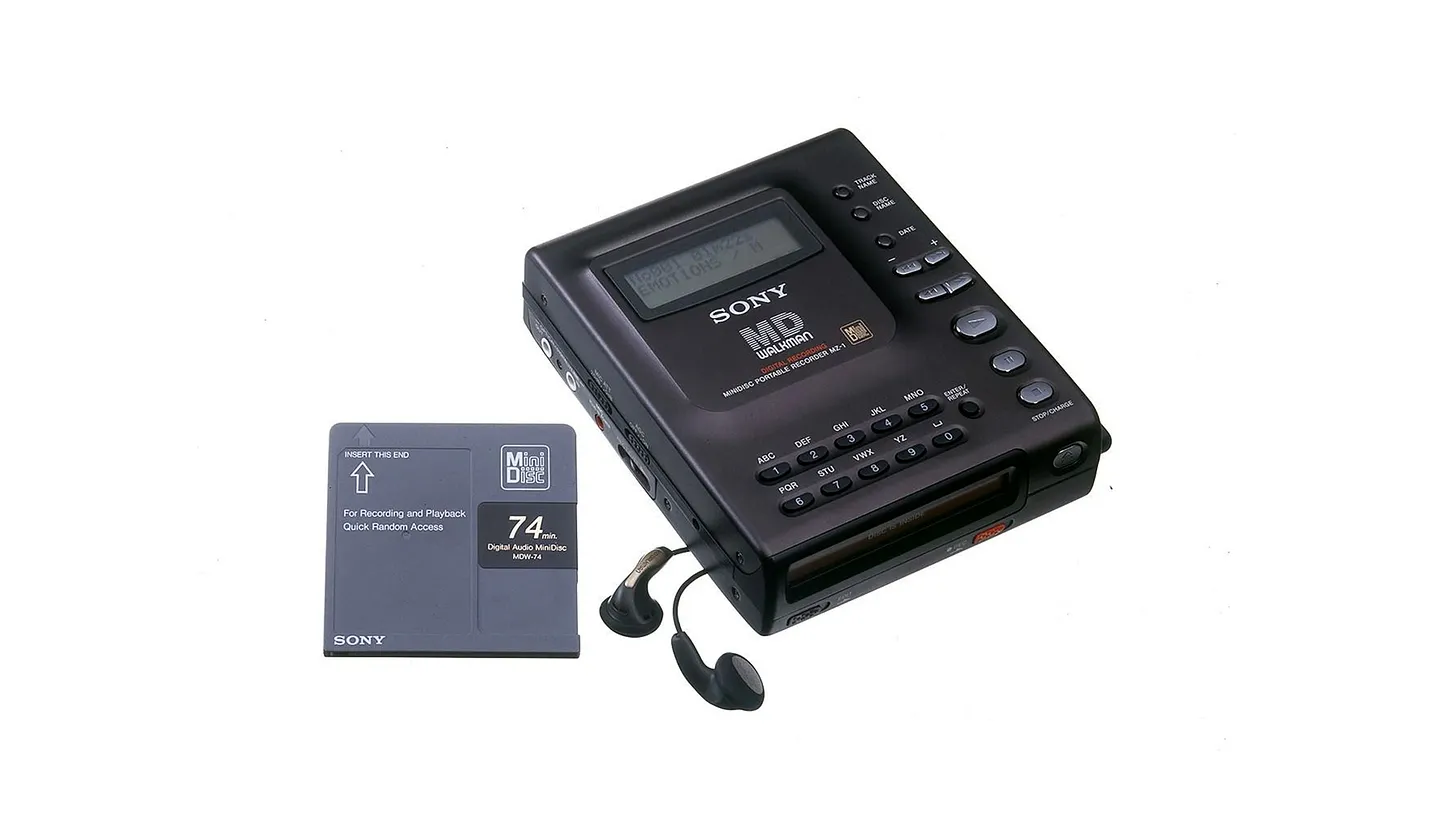
When you write a CD-R, a laser literally burns, reaching a temperature of 250 degrees Celsius, to create a layer of dye with a pattern of reflecting and non-reflecting parts, which will be read as binary code. This process doesn't guarantee a long lifespan of the saved data. God only knows how many CD-R and DVD-R or RW I have thrown away over the years. Magneto-optical discs (MiniDiscs), work differently, and in a way that makes them more durable. A laser heats up to the Curie point (180°) of the disc and a magnetic head polarises the disc with a negative or positive charge, imprinting a binary code that will be read by a laser.
The advantage of this technology? A Minidisc is virtually immune to heat and magnetic fields, becoming an almost time-proof medium, capable of being rewritten an infinite number of times and keeping the information forever without degradation.
There are some cases of very cheap and unreliable MiniDiscs, mainly sold in Japan, or the ES MiniDiscs, which, for a stupid reason of exclusivity, are not exactly heat-friendly.
So, if MiniDiscs are so fantastic, why are they not universally used? Why have some people never even seen one? To reply to this question, we have to jump back to the ‘90’s.
Let's imagine being a teenager in the ‘90s. Always with empty pockets and always fighting against the nemeses of empty batteries, acne, and the prices of DiskMan CD players. CD was already the standard in music, and the arrival on the market of affordable CD burners was only a matter of time. Many teenagers (like me) were still using compact cassettes for their own backup as well as for sharing music - and to people like me, the idea to buy a battery-eating, chunky and expensive MD writer/player, capable of only 74 minutes of music, as the MZ1 was absolutely idiotic.
To me, the MiniDisc only started to be interesting in 2001 thanks to NetMD technology which allowed you to connect your portable devices via USB and write your diligently illegally downloaded .wav and .MP3 music collection in a truly portable 80-minute media with the incredible capacity of playing 50 h of music with a single AA battery.
At that point, the MD was a must for me and I was seeing the difference between them and CDs in the backup and mixtape use every single day. Many of my friends were struggling to get their portable CD players to read their home burned CD-Rs. Meanwhile they were getting mental seeing me copy their albums from my MZ-N1 directly on the beach and sometimes even more albums on a single MiniDisc thanks to the LP2 compression that doubled the capacity of the MiniDiscs, while maintaining a much higher quality of sound compared to any type I compact cassette.
The fact that I was capable of writing the titles of the tracks or changing their position directly from my portable device thanks to Random Access and TOC was incredible when 99% of people didn't have a CD-Text at home in their main hi-fi system.
In time Data MD and hi-MD capable of storing up to 1 GB came onto the market but people were attracted by the lower price of CD-R and their faster speed of writing, not realising they essentially storing their precious data on toilet paper. As a result, the Minidisc market started to decline and slowly die.
But did it really die? Obviously not. A very strong and populated base of fans of this format is still alive and is the subject of one of the most fantastic internet communities on all social platforms. Thanks to the time and determination of some great people, such as Stefano Brilli with is Web MiniDisk Pro, today it is possible to record a MD from a smartphone, create a label online or using a template, or, thanks to UV printers, print directly on a MiniDisc with a personal design, making this format look like never before.
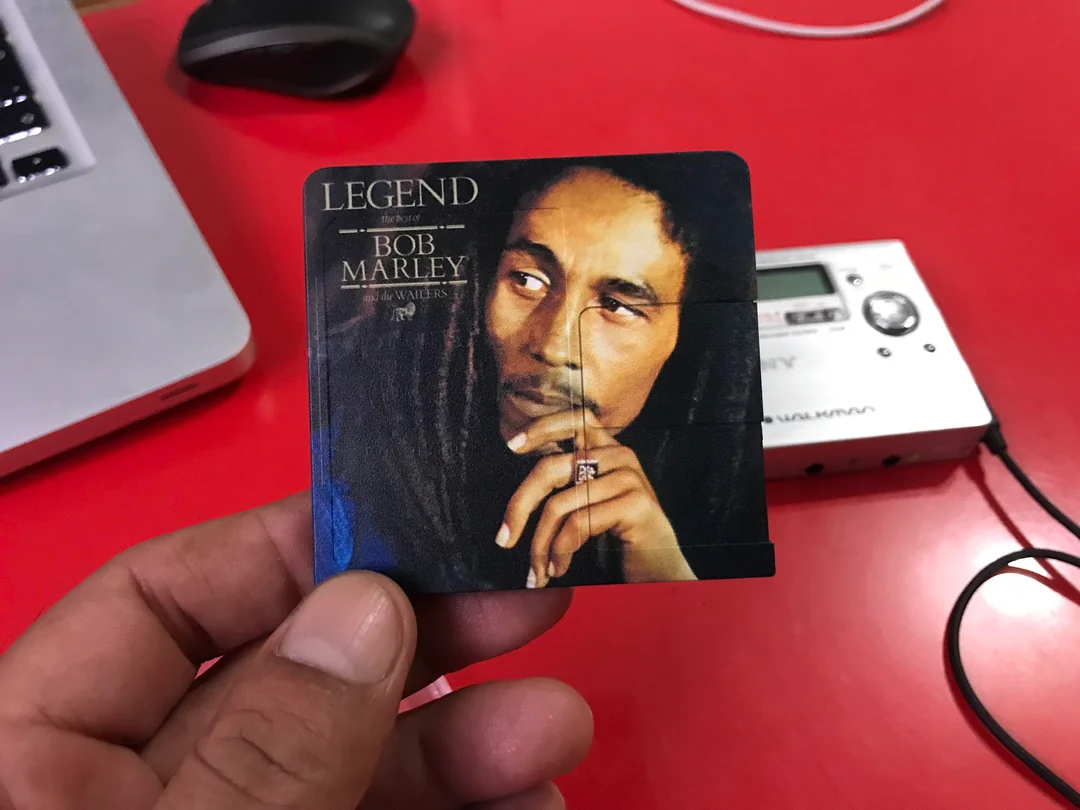
Today MiniDiscs, in my opinion, are the best physical media to store downloaded digital music and thanks to their durability and proof of concept over time a larger number of people have changed their mind about MiniDiscs.
Unfortunately, the production of this media has been stopped in recent times and restarting it will cost a fortune but we are every day more used to this kind of resurrection. Look what happened with Polaroid and the Impossible Mission Company, with analogue photography in general, Lomography and last but not least, vinyl records.
MiniDisc is not a thing of the past, and in fact deserves to be the future of home recording.